



How to Choose Veining for Islands With Confidence
An island is where a kitchen gathers its attention. It is also where the stone has the most room to speak. When you choose veining for islands, you are deciding more than color. You are choosing the movement, balance, and personality that will shape the entire room.
A quiet island can bring order to detailed cabinetry and statement lighting. A boldly veined slab can become the focal point that makes a new kitchen feel one of a kind. The right decision comes from seeing the whole slab, understanding how it will be cut, and considering how your household will use the space.
Start With the Island's Role in the Kitchen
Before selecting a stone, look at what the island needs to do visually. In a kitchen with simple painted cabinets, restrained backsplash tile, and warm wood floors, expressive veining can provide depth without making the room feel busy. A dramatic quartzite, marble, or granite may be exactly what gives the design its signature.
If the kitchen already includes patterned tile, ornate hardware, richly grained wood, or several competing finishes, a calmer slab may be the better choice. Soft, linear veining or a more consistent field color allows the island to feel elevated while giving the other elements room to breathe.
There is no rule that says an island must be more dramatic than the perimeter countertops. Still, it is often the natural place to use the slab with greater movement. Perimeter runs are interrupted by sinks, ranges, appliances, and short walls. An island offers a broad, uninterrupted canvas where a beautiful vein can be appreciated from across the room.
Consider the Scale of the Veining
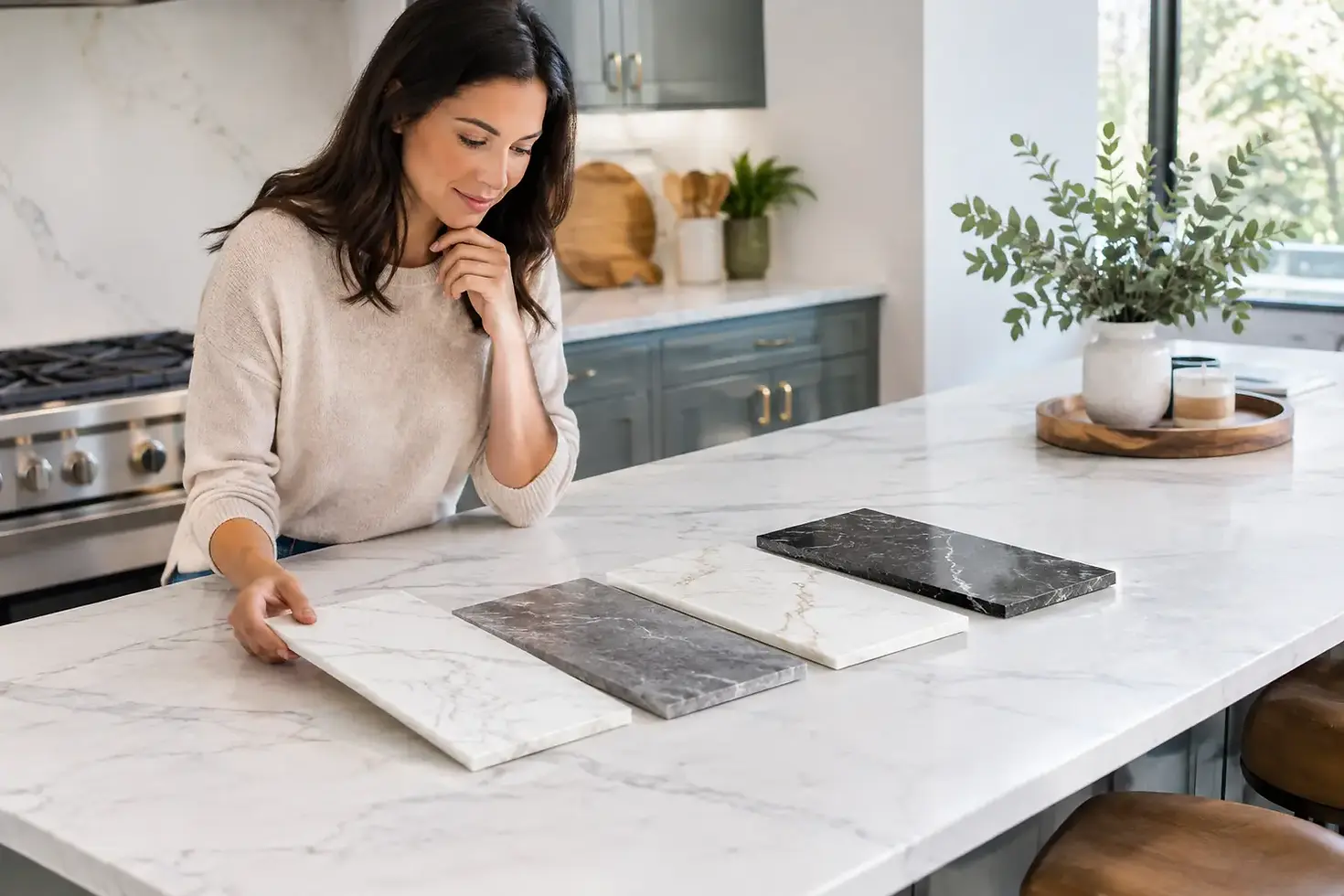
Veining has scale, just like cabinetry and lighting. Fine, delicate veins read differently from wide bands of color or sweeping mineral movement. A vein that looks subtle on a small sample can become powerful across a ten-foot island, which is why a hand sample is only the beginning of the selection process.
Fine veining suits kitchens that call for a tailored, quiet finish. It can add detail to white, cream, gray, or soft green cabinetry without taking over the room. This look is often appealing in smaller kitchens or open floor plans where the island is visible from several spaces.
Medium-scale veining offers a balanced look. It creates visual interest from a distance while remaining easy to pair with cabinetry, fixtures, and backsplash materials. For many Savannah-area homes, this is the sweet spot: distinctive enough to feel personal, yet timeless enough to work through future updates.
Large, sweeping veining makes a stronger statement. It is especially striking on oversized islands, waterfall ends, and open-concept kitchens with high ceilings. The trade-off is that bold movement asks for more restraint elsewhere. Let the stone lead, then choose supporting finishes that complement rather than compete.
Look at Movement, Not Just Color
Two slabs can share a similar white or gray background and create entirely different effects. One may have long, directional veins that guide the eye across the island. Another may have cloud-like movement, branching lines, or concentrated areas of mineral color. Those patterns determine whether the surface feels calm, architectural, organic, or dramatic.
Directional veining can visually lengthen an island when the fabricator lays it along the long edge. Cross-cut movement can make the piece feel wider and more active. Neither approach is automatically better. The decision depends on the room's proportions, sight lines, and the effect you want when entering the kitchen.
Ask to view the slab from several feet away, then step close enough to see the finer detail. A stone should work at both distances. From across the room, it needs a clear, pleasing composition. Up close, it should reward attention with natural variation and depth.
Choose Veining for Islands by Viewing the Full Slab
Natural stone is not a printed pattern. Every slab has its own veining, color shifts, fissures, mineral deposits, and areas of movement. That individuality is the point, but it also means the exact slab matters.
A full slab view lets you see where the strongest veining sits and how it may land after fabrication. A striking vein near one corner could become the front edge of the island, a waterfall panel, or an area removed for the sink cutout. Seeing this before a final decision helps prevent surprises later.
At Garpa Co.'s slab gallery, homeowners, designers, and fabricators can compare full slabs in person and hand-pick the material that fits the project. Bring cabinet samples, flooring, paint colors, backsplash selections, and metal finishes when possible. Natural stone changes character under different light and beside different materials.
It also helps to take a photo of the slab with a person standing nearby. This gives you a better sense of scale than a close-up image alone. A beautiful detail can look much larger in a photograph than it will on an island, while a broad vein may be more commanding in person.
Plan the Layout Before Falling in Love With a Pattern
Once you find a slab you love, the next question is not simply whether it fits. It is how the fabricator will use it. A layout discussion should happen before fabrication, especially with pronounced veining or a large island.
The fabricator can mark the island shape on the slab and show where edges, seams, cutouts, and waterfall panels will fall. This is the moment to decide whether a focal vein should run down the center, sweep toward the seating side, or frame the cooking area. If your island includes a sink, cooktop, or oversized outlet, ask how those cutouts will affect the composition.
Waterfall ends deserve special attention. A continuous vein flowing from the countertop down the side can look extraordinary, but it requires careful planning and enough material. Depending on the stone pattern and slab dimensions, a continuous look may require additional slab yardage. It is an investment, though one that can make the island feel like a sculptural feature rather than simply a work surface.
Bookmatching is another option for slabs with dramatic, mirrored movement. Two slabs are opened like the pages of a book to create a symmetrical pattern. It can be spectacular on a large island or feature wall, but it is inherently bold. If you prefer a more natural, relaxed result, a flowing, non-mirrored layout may feel more at home.
Match the Stone's Character to Everyday Use
The most beautiful slab should also suit the way you live. Marble offers classic veining and luminous depth, but it can etch when it meets acidic foods and drinks. Many homeowners welcome that soft patina as part of marble's character. Others prefer a material with more resistance for a busy island used for meals, homework, and entertaining.
Quartzite often provides dramatic movement with excellent durability and heat resistance, making it a compelling choice for active kitchens. Granite offers a broad range of colors and patterns, with strong everyday performance. Soapstone brings a softer, understated veining style and develops a rich patina over time. Each natural material has its own look, care needs, and honest character.
Do not choose a stone only because it resembles another material. Choose it because you appreciate what it actually is. The most lasting interiors make room for natural variation rather than expecting a living material to behave like a manufactured surface.
Check Veins Under Your Kitchen Lighting
Coastal light can be bright and changeable. A slab that looks crisp white in a showroom may read warmer at home, while blue-gray or gold veins may become more noticeable under evening pendants. Review your selection in daylight, if possible, and consider the temperature of your planned lighting.
Warm lighting tends to draw out cream, taupe, and gold tones. Cooler light may emphasize gray, blue, or charcoal movement. This does not mean you need to match every undertone perfectly. A little contrast often gives a kitchen its depth. The goal is for the stone to feel intentional with the finishes around it.
Let the Slab Give You a Clear Answer
The best island stone is rarely the one that looks most perfect in a small sample. It is the slab that still feels right when you see its full scale, imagine its veins in the planned layout, and picture your family gathered around it for years to come.
Take your time in front of the slabs. Notice which one keeps drawing you back. When the veining has the right balance of movement, color, and character for your home, the decision often becomes wonderfully clear. A rock is forever, and the right one will make your island feel unique like you.


Comments